Two numbers get asked on every call: how fast is it, and how thick can it weld. The first answer is on the datasheet. The second answer is not a machine limit at all — and understanding why will save you from buying the wrong thing.
A welding carriage travels at a set speed and holds it. What that speed can be is decided by how much metal the process can deposit, which depends on current, wire diameter, wire feed rate, gas and the joint volume — not on the carriage.
Take a 6 mm fillet: the cross-section is about 18 mm². At 400 mm/min you are depositing roughly 3.8 kg of wire per hour, which is already near the comfortable ceiling of a 300 A CO₂ MAG set. Ask the same machine to run 800 mm/min on that joint and no carriage in the world will help, because the weld would be starved.
So the honest answer to "how fast" is: the carriage covers 0–1100 mm/min, and your real speed is whatever your power source can deposit properly. What the machine gives you is that speed held constant for the whole seam, which is what makes the bead look uniform.
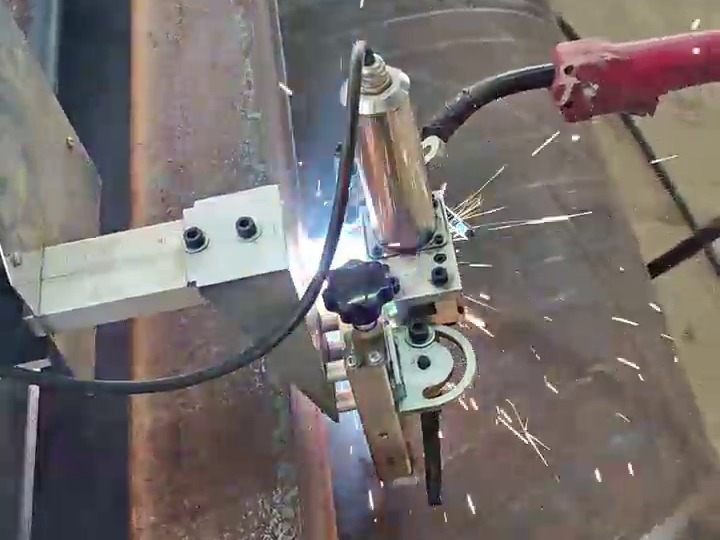
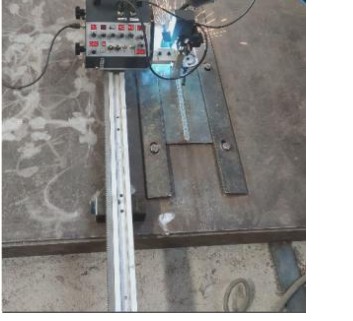
Rough figures for CO₂ MAG single pass, steel, using a 1.2 mm wire. Treat them as a sanity check on your procedure, not as a setting to copy.
| Fillet leg | Travel speed | Wire deposited | Power source you need |
|---|---|---|---|
| 4 mm | 600 mm/min | ~2.5 kg/h | 200–250 A |
| 6 mm | 400 mm/min | ~3.8 kg/h | 250–300 A |
| 8 mm | 300 mm/min | ~5.0 kg/h | 300–350 A, or split into two passes |
| 10 mm and above | Multi-pass | — | Single pass stops being practical; run passes and keep the travel speed constant on each one |
The flip side of constant speed is constant heat input, which is the real reason to mechanise: identical penetration on pass one and pass fifty, without relying on how fresh the welder is.
Thickness changes the procedure, the number of passes and how much distortion control you need. It does not change the carriage.
| Thickness | Effect on the carriage | What to actually watch |
|---|---|---|
| Under 3 mm | Cannot use magnetic adhesion | The magnets cannot develop holding force; fixture the joint or weld manually |
| 3–4 mm | Minimum range for RG / ZG / CX (4 mm for JJ) | Clean, flat steel matters more here than on thick plate — thin plate flexes |
| 4–20 mm | Comfortable range, no machine-side limits | Joint preparation, root gap consistency and travel speed |
| 20–40 mm | No machine-side limits; more passes | Interpass temperature, distortion control, pass sequence |
| Over 40 mm | Same machine, longer procedure | Heat input control and interpass temperature become the whole job |
Plate thickness limits welding procedure, not the carriage. The only thickness number that concerns the machine is the minimum for magnetic adhesion.
Send us the joint type, leg size or wall thickness, plate thickness and your power source. We will come back with a starting travel speed and oscillation setup instead of a datasheet range.