Little Gecko® welding carriages · Engineering, QC & worldwide export from Beijing, China
Home / Applications / Steel Structure

Steel Structure Welding — Fillet Welds That Never Get Tired

Structural shops live on fillet welds. The joint is always the same — what varies is whether a person has to hold the torch at 45° for a full shift. Our trackless fillet carriages ride the beam and keep the angle perfect. A steel structure welding carriage replaces the welder's hand with a constant 45° angle and a constant travel speed, beam after beam, shift after shift.

Steel Structure Welding

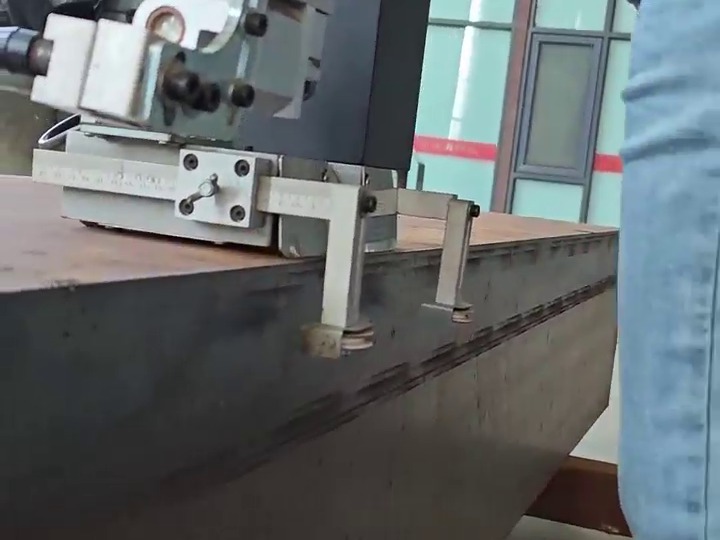
Ride the beam — no track, no jig, no fixture

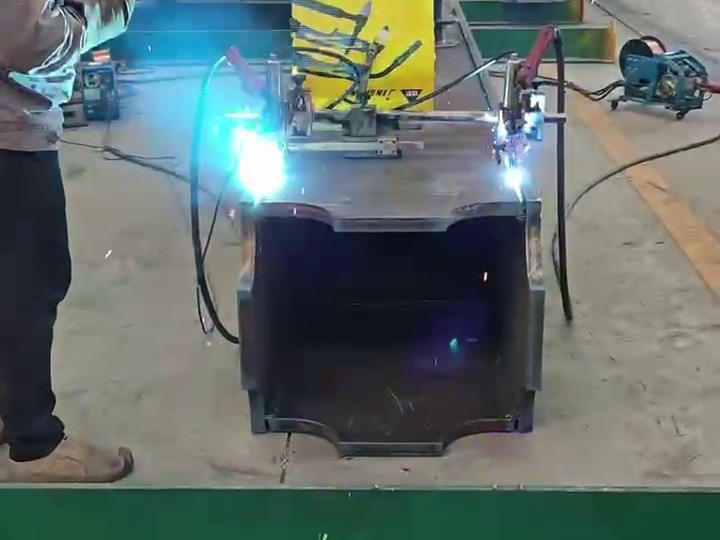
H-beam and box beam fillets are the volume weld of the fabrication industry, and they are exactly where shift-long manual welding hurts: the torch angle drifts, leg length varies, and the second side of the beam needs a whole second setup. A trackless magnetic carriage rides the joint itself and, in the dual-torch version, welds both fillets in one pass.
  • Continuous fillet welds on H-beams, box beams, frames and gussets
  • Dual-torch versions cover web-to-flange widths from 400 to 800 mm
  • Rubber-wheel drive for clean surfaces, steel-wheel GJ versions for scale and heavy sections
  • Works on magnetically permeable steel — carbon steel, Cr-Mo steel, low-alloy steel
What we recommend: JJ rubber-wheel carriage for clean plate, GJ steel-wheel versions for scale and heavy beams — and the Q2 dual-torch models to weld both fillets in one pass. The CZ-III-Q1 side-mount reaches corners where the carriage cannot sit over the joint.
The difference: With a dual-torch carriage, one pass does what used to take two setups. Swing width and angle are set once per beam family, so quoting per metre of weld instead of per shift becomes realistic.
See the JJ / GJ Fillet Carriage
Dual-torch fillet carriage welding both seams of a box beam in one pass — real photo Fillet welding carriage riding a box beam edge — real photo
Seam Types We Cover

Which Carriage Welds What in Steel Structure

Typical joint / seamRecommended machine
Single fillet welds on beams & framesJJ-III-Q1/J-W fillet carriage
Both fillets of a beam in one pass (400–800 mm)JJ-Q2 dual-torch carriage
Heavy, scaled or weathered sectionsGJ steel-wheel carriage
Corners & inaccessible jointsCZ-III-Q1 side-mount carriage
Watch It Work

Automatic Fillet Welding on Beams & Structures

Fillet carriage welding a structural joint — real footage
FAQ

Steel Structure Welding — Common Questions

Do the magnet wheels affect the weld?
No — the magnet structure and pole arrangement are designed so the field does not influence the arc. The wheels keep full strength below 300 °C, and there are no friction wear parts on the travel path. The joint quality is set by your parameters, not by the machine's grip.
Can it handle the second fillet without re-fixturing the beam?
Yes — that is exactly the dual-torch (Q2) configuration: one carriage, two torches, both fillets welded as the carriage makes a single pass. Web-to-flange widths from 400 to 800 mm are covered. For single-torch shops, the carriage is simply turned to the other side for the second pass.
Our beams are rusty and scaled — still trackless?
Specify the GJ steel-wheel version: it is built for scale and heavy sections where rubber wheels would pick up debris. Grip comes from the internal permanent magnets either way, so painted or lightly rusted steel is fine for both versions.

Running H-Beams, Box Beams or Frames?

Send us your typical beam size and fillet leg length — we will size the single or dual-torch carriage and quote within 24 hours.

Get a Quote