A turning roll is the obvious answer to a circumferential weld — until the spool is 12 metres long, already sitting in its supports, or simply too big to lift. Then the workpiece stays still and the machine has to travel instead.
Rotating the workpiece is the cheapest way to put a circumferential weld into the flat position — when you can. The problems start with long spools that will be installed as they are, with pipes welded in situ, with large-diameter shells, and with jobs where setting up a rotator costs more than the weld itself.
A magnetic crawler welding carriage solves the same problem from the other side: the pipe stays where it is and the carriage walks the circumference. No turning roll, no positioner, no crane, no ramps. It grips the pipe with magnetic wheels and drives itself around the joint at a constant speed, so every degree of the circle gets the same heat input as every other.
The trade is diameter: the crawler welds pipe from Ø108 mm outer diameter and inner shells from Ø700 mm, and it needs magnetically permeable material at least 3 mm thick.
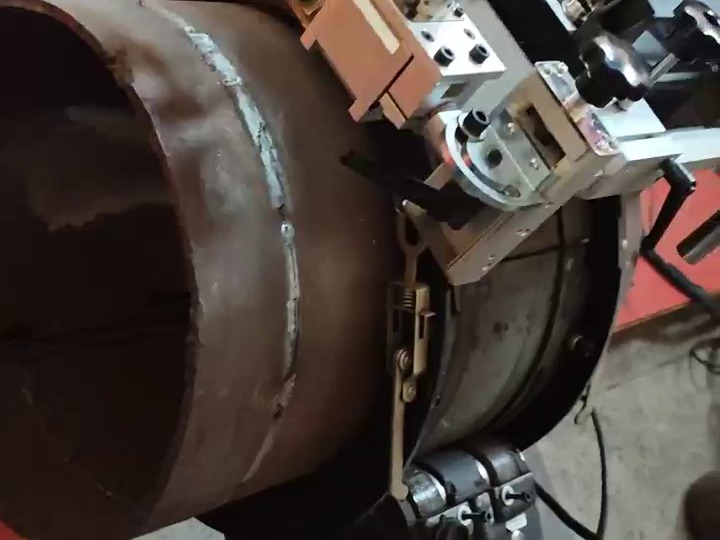
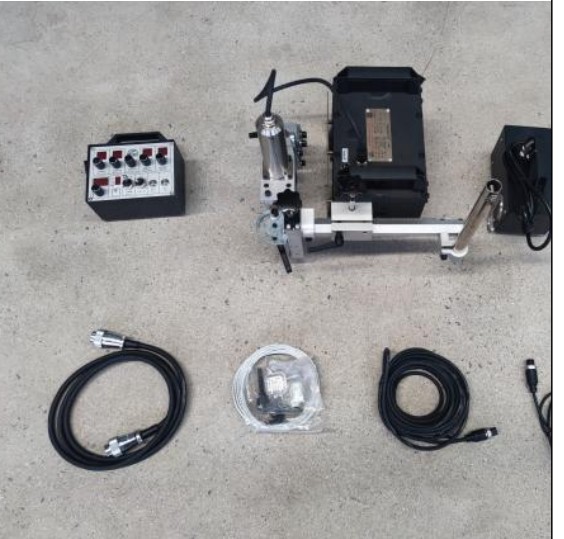
Rotator, positioner, crawler or manual — the right answer depends on whether the pipe can be moved and how big it is.
| Situation | Usual method | Where the crawler fits in | Practical note |
|---|---|---|---|
| Short spool, can be lifted | Turning roll | Alternative if the roll is busy | Turning is still the fastest route when the workpiece is light and free |
| Spool welded in place in its supports | Crawler carriage | The main application | Nothing to rig, nothing to lift, workpiece stays in position |
| Outer diameter under Ø300 mm | Crawler carriage | From Ø108 mm | There is no room for a rail or a turning roll on small pipe |
| Large-diameter shell or vessel | Rotator or column-and-boom | Flexible track or crawler | RG flexible track from Ø1800 mm; the crawler has no minimum |
| Inner shell from Ø700 mm | Manual or crawler | Crawler carriage | The crawler goes inside; a rotator cannot help from outside |
| Stainless or aluminium pipe | Rotator + manual | Not magnetic — discuss fixtures | Magnetic drive needs ferrous material; ask about vacuum or clamping options |
Constant heat input around the circle is the real gain. On manual circumferential welding the position changes continuously — flat at the top, vertical at the side, overhead at the bottom — and the welder compensates by hand. The carriage removes that variable entirely.
Four adjustments, and the same procedure works for pipe, tank shells and vessel bodies.
Magnetic wheels need clean, dry, scale-free steel. Mill scale and rust reduce holding force and make the carriage wander, so wire-brush the two tracks the wheels will follow.
Set the machine on the pipe at the start point, adjust the torch to the joint with the vertical and horizontal slides, and check the wire aims into the root — not at the bevel face.
Pick the travel speed from the joint volume, then set oscillation width and dwell. For a cap pass, a wider oscillation with a short dwell at each end keeps the edges filled without undercut.
The first quarter tells you whether the torch stays on the seam as the pipe's roundness changes. If it drifts, fit the anti-drift fixture rather than fighting it with the remote.
Send us the pipe diameter, wall thickness, material and whether the spool can be rotated. We will tell you whether the crawler covers it and which track variant you need.